
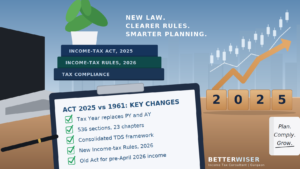
Income-tax Act, 2025 vs Income-tax Act, 1961: Key Changes Every Taxpayer Should Understand
The Tax Law You Knew for 65 Years Has Changed. Are You Ready?
Ask any salaried employee, business owner or professional in India what “Assessment Year” means, and you will usually get a long pause. For decades, India’s tax law made people juggle two years for one income: the year you earned it and the year you paid tax on it.
From 1 April 2026, that era is over. The Income-tax Act, 2025 has replaced the Income-tax Act, 1961, the law that governed Indian taxation since 1962 and picked up thousands of amendments along the way. Whether you earn a salary, run a business, invest in the market or advise clients, the new framework changes how you read, file and plan your taxes.
At Betterwiser Services Private Limited, we have been helping individuals and businesses with tax and compliance since 2004. We have seen how a change in law creates both confusion and opportunity. This guide explains the Income-tax Act, 2025 in plain language: what has changed, what has stayed the same, and what you should do about it.
Why Was a New Income-tax Act Needed?
The 1961 Act was a product of its time. Over six decades it was amended again and again through Finance Acts, adding provisos, explanations, cross-references and exceptions. The result was a law that few taxpayers could read without professional help.
The government’s stated objective with the new Act is clear: simplify the language, reduce the clutter, and make the law easier to navigate, without changing the fundamental tax burden on taxpayers. The Income-tax Bill, 2025 went through a Select Committee review. It received Presidential assent on 21 August 2025 and came into force on 1 April 2026.
Rewriting a law this large is a big exercise, and the Act should be seen as a restructuring and simplification effort, not a tax-rate overhaul.
At a Glance: Income-tax Act, 1961 vs Income-tax Act, 2025
| Feature | Income-tax Act, 1961 | Income-tax Act, 2025 |
| Effective from | 1 April 1962 | 1 April 2026 |
| Core year concept | Previous Year + Assessment Year | Single “Tax Year” |
| Approximate sections | 800+ (after decades of insertions) | 536 |
| Chapters | 47 | 23 |
| Schedules | 14 | 16 |
| TDS provisions | Spread across 60+ sections (192 to 194T and others) | Consolidated into a few sections (mainly 392 to 394) |
| Rules and forms | 511 rules, 399 forms (Income-tax Rules, 1962) | 333 rules, 190 forms (Income-tax Rules, 2026) |
| Language style | Dense, proviso-heavy | Tables and simplified drafting |
The numbers are striking, but the real story is what they mean for you.
Key Change #1: The “Tax Year” Replaces Previous Year and Assessment Year
This is the headline change, and the one that will touch every taxpayer.
Under the 1961 Act: Income earned in Financial Year 2025-26 was called “Previous Year 2025-26”, and it was assessed in “Assessment Year 2026-27”. Many people filed returns for “AY 2026-27” without being fully sure which year’s income they were reporting.
Under the 2025 Act: Section 3 introduces a single concept, the Tax Year, running from 1 April to 31 March. Income earned in Tax Year 2026-27 is reported as Tax Year 2026-27. There is no separate assessment year to decode.
What this means for you:
- Fewer mix-ups while filing returns, paying advance tax or responding to notices.
- Cleaner communication between you and your tax advisor.
- A simpler mental model: one year, one label.
An important transition point: Income earned before 1 April 2026 continues to be governed by the 1961 Act, even if assessment, scrutiny or appeals happen after that date. That means both laws will live side by side for a good number of years. Pending assessments, reassessments, appeals and refunds for older years will still be handled under the old provisions.
Key Change #2: A Leaner, Better-Organised Structure
The 1961 Act had grown to more than 800 effective sections, many carrying suffixes like 80IA, 115BAC, 194J and 10(23FE). The 2025 Act brings this down to 536 sections across 23 chapters, with related provisions grouped together more logically.
What this means for you:
- Easier navigation of the law, especially for first-time readers.
- Section numbers you have memorised for years will change. 80C, 194C, 44AD and 143(1) will have new equivalents, and you will need a mapping reference for a while.
- Professionals, ERP vendors, payroll software and accounting systems all need to update their references.
If your internal documents, agreements, templates or compliance calendars refer to old section numbers, this is a good time to review them.
Key Change #3: TDS and TCS Provisions Consolidated
If you run a business, this change matters a lot.
Under the 1961 Act, tax deduction at source was scattered across dozens of sections: 192 for salaries, 194A for interest, 194C for contractors, 194H for commission, 194I for rent, 194J for professional fees, and many more. Each had its own rate, threshold and proviso.
The 2025 Act pulls these into a consolidated TDS framework, with provisions housed in a small set of sections, mainly Section 392 (salary) and Section 393 (other payments, presented in tabular form), along with a section for TCS.
What this means for you:
- The underlying rates and thresholds for most payments continue largely as before, so this is primarily a restructuring, not a new tax.
- Your accounts team needs to update how it tags TDS sections in books, challans and returns.
- Vendor onboarding, TDS certificates and return reconciliation will all reflect the new references.
At Betterwiser, our accounts outsourcing and compliance teams help businesses remap their TDS workflows so that nothing falls through the cracks during the transition.
Key Change #4: New Income-tax Rules, 2026 and Simplified Forms
A law is only as practical as the rules and forms that support it. Alongside the Act, the Income-tax Rules, 2026 came into force on 1 April 2026, replacing the Income-tax Rules, 1962.
The headline numbers: the old rulebook of roughly 511 rules and 399 forms has been compressed to about 333 rules and 190 forms. Forms have been renumbered and consolidated, and several procedural requirements have been streamlined.
What this means for you:
- Familiar form numbers (many of us know Form 15G, 26AS and 10-series forms by heart) may now carry new identities.
- Employers need to revisit salary structures, perquisite valuation and allowance treatment under the updated rules.
- Return filing utilities and portal workflows will reflect the revised forms.
Do not rely on old memory or old templates. A wrong form reference may not feel serious, but it can delay processing, trigger defects or invite avoidable notices.
Key Change #5: Tax Regimes, Slabs and Rates Remain Stable
This is the part many taxpayers are relieved to hear.
The new Act is not a rate-change exercise. The choice between the concessional (new) tax regime and the older regime with deductions continues. Slab rates for the first year under the new law were retained, and the broader architecture of deductions, exemptions and capital gains taxation carries over, with rationalised drafting and renumbering.
The provisions of old Section 115BAC (the new tax regime), for example, are now housed under a fresh section in the 2025 Act, but your regime-selection decision still works the way you know it.
What this means for you:
- You do not need to panic about sudden changes in your tax outgo purely because the Act has changed.
- You do need to keep up with each year’s Finance Act, which continues to adjust rates, thresholds and specific provisions within the new framework.
- Annual tax planning still matters. The choice of regime, the timing of investments and the structure of income all affect your final liability.
Key Change #6: Recognition of Digital Assets and Modern Realities
The 1961 Act was drafted when computers were science fiction. Over the years, patches were added for virtual digital assets, e-commerce, faceless assessments and digital compliance.
The 2025 Act weaves in this modern context more naturally. Virtual digital assets, digital reporting and technology-driven administration are treated as part of the core framework rather than as late additions.
What this means for you:
- Investors and traders in digital assets should make sure their records, valuation and reporting are in line with the revised provisions.
- Businesses that transact online, across borders or through platforms should review their documentation and reporting practices.
- Technology-based assessments and communication through the portal will remain central.
Key Change #7: Greater Rule-Making Flexibility for the CBDT
The new framework gives the Central Board of Direct Taxes more room to deal with procedural matters, compliance frameworks and operational details through rules. That can make the system more responsive, and it means taxpayers must watch CBDT notifications, circulars and rules more closely than before.
What this means for you: Compliance is no longer a once-a-year activity. Staying updated through the year is part of managing tax risk.
What Stays the Same? (Don’t Overlook This)
In all the excitement, it is easy to forget that much of your tax life continues as before:
- Core principles of taxation: heads of income, residential status, total income computation and set-off of losses stay conceptually intact.
- Return filing discipline: timely filing, advance tax payments and responding to notices are as important as ever.
- Documentation: invoices, bank statements, Form 26AS/AIS reconciliation and supporting records remain essential.
- Penalties and interest for non-compliance: these continue, in updated section references.
The new Act changes the packaging far more than the principles.
The Transition Challenge: Two Laws, Running in Parallel
Here is where many taxpayers will struggle. For years to come:
- Old income (up to 31 March 2026) will be assessed, reassessed, appealed and litigated under the 1961 Act.
- New income (from 1 April 2026) falls under the 2025 Act.
So a business may face a scrutiny notice for Assessment Year 2024-25 under the old law while also filing its first return under the new law. Someone carrying forward losses, claiming a refund or defending a past demand must navigate both frameworks at once.
This is why continuity in professional support matters. You need an advisor who understands both statutes and can connect them for your case.
Your Practical Action Checklist
Whether you are an individual or a business, these steps will help you handle the transition smoothly:
For individuals and salaried taxpayers
- Review your salary structure, allowances and perquisites in light of the new rules.
- Reassess the choice between the new and old tax regime for the current Tax Year.
- Update your tax planning calendar using “Tax Year” terminology.
- Keep proof of investments, rent, loans and other claims organised.
For businesses and professionals
- Update accounting software, payroll tools and ERP systems with the revised section references.
- Retrain your accounts and finance teams on the new TDS/TCS structure.
- Review contracts, templates and internal policies that cite old sections.
- Reconcile TDS/TCS data regularly with the tax portal to avoid mismatches.
For startups, SMEs and growing companies
- Reevaluate tax structuring, especially for expansion, funding and cross-border transactions.
- Keep documentation for related-party dealings, transfer pricing and international payments up to date.
- Seek professional review before taking major tax positions in the first years of the new law.
Why Work With a Professional Income Tax Consultant During This Transition?
Reading a new Act is one thing. Applying it to real transactions is another. A qualified income tax consultant helps you with:
- Interpretation: how a specific provision applies to your facts.
- Mapping: linking old provisions to new ones without gaps.
- Planning: structuring income, investments and business operations lawfully and efficiently.
- Compliance: timely, accurate filings that avoid notices and penalties.
- Representation: responding to notices and assessments under either law.
If you are searching for an income tax consultant in Gurgaon, you want someone who combines technical depth with practical, client-first service. At Betterwiser, our income tax consultancy services in Gurgaon cover:
- Income tax return filing for individuals, firms and companies
- Tax planning and advisory
- TDS/TCS compliance and return preparation
- Response to notices and departmental proceedings
- Tax structuring for businesses and Virtual CFO support
- Accounts outsourcing and payroll consultancy
- Business setup, registrations and ongoing compliance
Whether you need a one-time consultation or ongoing income tax consultancy services for your business, our team works with you to keep your tax affairs accurate, compliant and optimised. You can learn more about our offerings on our Income Tax services page.
Conclusion and Key Takeaways
The Income-tax Act, 2025 is the biggest structural reform of India’s direct tax law in over six decades. It simplifies the language, trims the sections and consolidates the rules, but the responsibility to comply falls squarely on the taxpayer.
Key takeaways:
- The Income-tax Act, 2025 is in force from 1 April 2026 and replaces the 1961 Act for income earned from that date.
- “Tax Year” replaces “Previous Year” and “Assessment Year”, giving one clear year reference.
- The Act is leaner, with 536 sections and 23 chapters instead of 800+ sections, but all your familiar section numbers have changed.
- TDS/TCS provisions are consolidated, so businesses must update their tagging, reporting and reconciliation processes.
- Income-tax Rules, 2026 bring fewer rules and forms, so old form references and templates should be retired.
- Rates and regimes remain stable, though annual Finance Acts will continue to bring changes.
- Both laws will run in parallel for years, because pre-April 2026 income continues to be governed by the 1961 Act.
- Professional guidance reduces risk, especially during the early years of the new framework.
Ready to Navigate the New Tax Law with Confidence? Talk to Betterwiser Today.
Don’t let the transition to the new Income-tax Act become a source of stress, errors or missed savings. Whether you are an individual taxpayer, a growing business or a startup, Betterwiser Services Private Limited is ready to guide you with clear advice, accurate compliance and personalised support.
Looking for a trusted income tax consultant in Gurgaon? Let’s talk.
📧 Email: support@betterwiser.co.in
📞 Phone: +91-98189 82759
Call or write to us today and book your consultation. Let Betterwiser take care of your tax compliance while you focus on what matters most: growing your business and your wealth.
For more information and updates, you can contact us or visit our website www.betterwiser.co.in.
About the Author: This article is contributed by CA Rajeev Gupta.
In case of any query please feel free to contact us at: support@betterwiser.co.in.
Disclaimer: This content has been prepared for the general guidance of the reader on matters of interest only. It should not be treated as professional advice. You should not act upon the information contained in this article without obtaining specific professional advice. No representation or warranty (express or implied) is given as to the accuracy or completeness of the information or provisions of the law contained in this article.
Author and/ or Betterwiser Services Private Limited, its Shareholders, Directors, employees, and agents accept no liability and disclaim all responsibility for the consequences of you or anyone else acting, or refraining to act, in reliance on the information contained in this article or for any decision based on it.
Frequently Asked Questions (FAQs)
- When did the Income-tax Act, 2025 come into effect?
It came into force on 1 April 2026 and applies to income earned from that date, starting with Tax Year 2026-27. - Is the Income-tax Act, 1961 completely repealed?
It has been replaced, but it continues to apply to income earned up to 31 March 2026. Assessments, reassessments, appeals and other proceedings for earlier years are still handled under the 1961 provisions. - What is a “Tax Year” under the new Act?
It is the 12-month period from 1 April to 31 March in which income is earned. It replaces the two-year system of “Previous Year” and “Assessment Year”. - Have income tax slabs and rates changed because of the new Act?
The new Act mainly restructures and simplifies the law. Rates and the choice between tax regimes continue as before, while each year’s Finance Act may adjust specific rates and provisions. - Will my existing section references, such as 80C or 194C, still work?
No. The new Act has a fresh numbering system, so familiar section numbers have new equivalents. It is wise to use a mapping table when updating documents, software and templates. - How has TDS changed under the new law?
TDS provisions that were spread across many sections are now consolidated into a few, mainly Sections 392 and 393. Businesses should update how they classify payments, issue certificates and file returns. - Do I need to learn new forms and rules?
Yes. The Income-tax Rules, 2026 replaced the older rules and reduced the number of rules and forms. Form numbers and procedures may differ from what you are used to. - Can I still choose between the new and old tax regimes?
Yes. Eligible taxpayers can continue to evaluate and choose the regime that suits their income and deductions, and the decision should be reviewed every year. - Which law will apply if I receive a notice for an old assessment year?
Notices and proceedings that relate to income earned before 1 April 2026 are generally governed by the Income-tax Act, 1961, even if they arise after the new Act came into force. - Will the due dates for filing returns change?
The new Act did not alter the practical rhythm of compliance, so timely filing, advance tax and TDS return discipline remain essential. Always check the latest notified due dates each year. - Does the new Act cover digital assets?
Yes. The framework integrates modern realities such as virtual digital assets and technology-driven administration, so investors and online businesses should review their reporting and record-keeping. - Should I hire a professional during this transition?
It is strongly advisable. A qualified income tax consultant can map old provisions to new ones, plan your tax position and handle compliance under both laws, which reduces errors and the risk of notices.