“Just Sign the SAFE”: Four Words That Can Cost an Indian Startup Dearly
It usually starts with an exciting email. A US-based angel or a global seed fund likes your pitch and wants to invest quickly. Then comes the message founders love and legal teams dread: “We’ll just use a standard SAFE. It’s a one-page document, and it takes five minutes.”
For a founder in Delhi NCR, Bengaluru or Mumbai, that sounds like a gift. No lengthy term sheet, no valuation negotiation, no shareholders’ agreement. But a SAFE built for a Delaware company does not automatically work for an Indian company. Used without adaptation, it can raise compliance problems under the Companies Act, 2013 and the Foreign Exchange Management Act (FEMA). These problems often surface years later, in the middle of a Series A due diligence.
At Betterwiser Services Private Limited, our startup advisory team regularly meets founders who closed an early cheque on a SAFE and only later learned that the paperwork didn’t fit Indian law. This guide explains the issue in plain language and shows the compliant routes available.
What Exactly Is a SAFE?
A SAFE (Simple Agreement for Future Equity) was popularised in the United States as a quick, founder-friendly way to raise early capital. In its standard form:
- The investor pays money to the company today.
- In return, the investor receives the right to get equity in the future, usually when the startup raises a priced round.
- There is no interest, no maturity date and no repayment obligation.
- The conversion price is typically set through a valuation cap, a discount, or both.
The attraction is obvious. Founders avoid fixing a valuation too early, and investors get a path to equity at a favourable price. In the US, the instrument works because US corporate and securities law allows this kind of contract.
India is different.
Why India Doesn’t Have a “SAFE” in Law
The Companies Act, 2013 recognises specific kinds of securities, mainly equity shares, preference shares and debentures. A pure SAFE, meaning money received today for an unspecified number of shares later, with no debt, no maturity and no fixed share terms, doesn’t fit neatly into any of these categories.
Indian law also takes a careful view of any money that a company receives from the public or from outside its shareholders. The rules on deposits, private placement and foreign investment are strict, and each has its own conditions and filings.
So when a US-style SAFE is signed by an Indian company, the legal character of that money becomes uncertain. That uncertainty is the root of most problems.
The Compliance Risks of Using a US-Style SAFE in India
- The “Deposit” Risk Under the Companies Act
This is the biggest concern. Under the Companies Act and the Companies (Acceptance of Deposits) Rules, money received by a company is treated as a deposit unless it falls within a specific exemption. Deposits are tightly regulated and, for private companies, subject to conditions on who can lend and how.
If a SAFE amount is not clearly classified as share application money, a recognised convertible instrument or another exempt category, there is a real risk that regulators or future investors treat it as an unauthorised deposit. The consequences can include penalties on the company and its officers, plus an obligation to repay.
Founders often overlook this because the money has been used for operations for months and “nothing has happened”. A due diligence team will notice it immediately.
- Private Placement and Allotment Compliance
When shares are eventually issued, they must follow the private placement framework, including the offer process, use of the proper bank channels, board and shareholder approvals, valuation requirements where applicable, and timely filings with the Registrar of Companies.
A SAFE signed informally, outside these procedures, makes it harder to show that the later share issue was compliant. Gaps in dates, approvals and filings can reduce the legal certainty of the shares your investor eventually receives.
- FEMA: Foreign Investment Has Its Own Rulebook
When the investor is outside India, FEMA and the Non-Debt Instruments (NDI) Rules apply. Foreign investment into an Indian company is allowed only through specified instruments such as equity shares, compulsorily convertible preference shares (CCPS), compulsorily convertible debentures (CCDs) and, for eligible startups, convertible notes.
A US-form SAFE is not one of these named instruments. Receiving foreign funds under such a document can create FEMA contraventions, which may need compounding with the RBI. That is a time-consuming and expensive process, and it can delay your next funding round.
- Pricing Rules: Valuation Caps and Discounts Don’t Always Fit
FEMA sets pricing guidelines for foreign investment. In general, shares issued to non-residents cannot be priced below the fair value determined under accepted valuation methodology. This creates a practical problem for the two features that make SAFEs popular:
- A discount (say 20% to the next round price) can result in a conversion price below fair value in some scenarios.
- A valuation cap can do the same if the cap sits below the fair value at the time of issue or conversion.
Because the conversion price in a SAFE is not known upfront, it becomes difficult to demonstrate FEMA pricing compliance. Our advice is simple: test every cap and discount against FEMA pricing norms before you sign, not after conversion.
- Reporting and Filing Obligations
Foreign investment must be reported to the RBI within prescribed timelines, typically through the FIRMS portal, with forms filed at the time of receipt of funds and again at the time of share issue. If the instrument itself is unclear, the correct reporting is unclear too, and missed or incorrect filings attract late submission fees and compliance notices.
- Tax Considerations
India has abolished the angel tax on share premium, which has removed one major headache for startups. But tax questions still arise on how the instrument is characterised, whether interest or other payments are involved, how TDS applies, and how gains are treated when the instrument converts. A SAFE with unclear legal status makes each of these questions harder to answer.
- Enforceability and Stamp Duty
An instrument that doesn’t fit into recognised categories may face questions on enforceability. Stamp duty on agreements also varies by state, and an informal document can create duty exposure later. These issues are rarely visible at signing, but they matter during diligence, exit and disputes.
A Quick Note: When a SAFE Does Work
If your startup has a foreign holding company (for example, a Delaware parent with an Indian subsidiary, the common “flip” structure), a standard SAFE at the parent level is perfectly normal. The compliance questions then shift to how money moves from the parent to the Indian entity, which is governed by FEMA rules on foreign direct investment and related filings.
The risk we are describing applies mainly when the Indian company itself signs a US-style SAFE.
The Compliant Alternatives for Indian Startups
The good news is that Indian law offers several well-recognised instruments. Each serves a different need.
Option 1: Convertible Notes
Indian law formally recognises convertible notes for eligible startups. As currently understood, the main conditions are:
- The issuer must be a DPIIT-recognised startup.
- The amount must be ₹25 lakh or more per investor, received in a single tranche.
- The note can be converted into equity (or repaid) within a period of up to 10 years.
- For foreign investors, FEMA conditions on eligibility, sectoral caps, pricing and reporting apply.
A convertible note is, legally, a form of debt that converts into equity. That makes it the closest statutory cousin of a SAFE. The trade-offs are the ₹25 lakh minimum, which excludes many small angel cheques, and the debt-like features (interest and maturity), which need careful drafting.
Option 2: iSAFE (India Simple Agreement for Future Equity)
The iSAFE is an Indian adaptation designed to give SAFE-like simplicity. It is generally structured as Compulsorily Convertible Preference Shares (CCPS), which are a recognised instrument under the Companies Act. Because it is share capital, it generally does not depend on DPIIT recognition, and it has been widely used by domestic angel networks and early-stage funds.
The caution here is that with foreign investors, FEMA’s pricing and upfront-formula requirements for CCPS must be satisfied. The “simple” document can still hide complex compliance.
Option 3: Compulsorily Convertible Debentures (CCDs)
CCDs have a well-established framework under the Companies Act. They suit situations where parties want more structure and are comfortable with a conversion formula fixed in advance.
Option 4: A Priced Equity Round
If the investor and founder can agree on a valuation, a straightforward priced round with proper share subscription and shareholders’ agreements remains the cleanest option. It costs more in time and legal fees, but it removes ambiguity.
Side-by-Side Comparison
| Feature | US-Style SAFE | Convertible Note | iSAFE (CCPS) | CCD |
| Recognised under Indian law | No, not as a named instrument | Yes, for eligible startups | Yes, as CCPS | Yes |
| DPIIT recognition needed | Not applicable | Yes | Generally no | Generally no |
| Minimum cheque | None | ₹25 lakh per investor (single tranche) | None specified | None specified |
| Foreign investor friendly | High FEMA risk | Yes, with conditions | Yes, with FEMA pricing compliance | Yes, with FEMA pricing compliance |
| Maturity | None | Up to 10 years | Conversion terms as agreed | Conversion terms as agreed |
| Main drawback | Deposit and FEMA risk | Debt-like features, ₹25 lakh floor | Pricing formula must be fixed upfront for non-residents | More structured and documentation-heavy |
Final suitability always depends on your sector, cap table and investor profile. Please confirm current conditions before relying on this table.
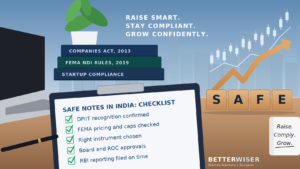
A Practical Checklist Before You Sign Any Early-Stage Instrument
Before accepting funds, ask these questions:
- Who is the investor? Resident or non-resident? This decides whether FEMA applies.
- Are we DPIIT-recognised? If not, convertible notes are not available to us for foreign investors.
- Which instrument fits? Note, CCPS, CCD or priced equity, and why.
- Does any cap or discount breach FEMA pricing? Get it checked before the term sheet is final.
- Is the sector eligible? Check the entry route and sectoral caps.
- Have we passed the right resolutions? Board and shareholder approvals, and any charter changes.
- Is the money coming through proper banking channels and with correct purpose codes?
- Are filings planned? RBI reporting, ROC forms and tax compliances, each with a timeline.
- Is the document Indian-law enforceable and properly stamped?
- Does our cap table stay clean after the instrument converts?
The Most Common Mistakes We See
- Copy-pasting a US template and changing only the company name.
- Treating the cheque as “just a loan from a friend abroad” with no instrument classification.
- Splitting a ₹25 lakh note into smaller cheques to fit a smaller investor budget, which breaches the single-tranche condition.
- Ignoring RBI reporting because the transaction “was small”.
- Waiting until the Series A diligence to discover the gaps, when fixing them is costlier and more stressful.
Early clean-up is far cheaper than late remediation. If you have already signed a SAFE, don’t panic. Many situations can be regularised or restructured with careful planning, ideally before the next round.
Why Startups Choose Professional Advisory for Fundraising
Fundraising is not only about getting a cheque. It is about building a clean legal and financial foundation that survives the scrutiny of the next investor. A qualified startup advisor helps you:
- Choose the right instrument for each investor type.
- Check FEMA pricing and eligibility before documents are signed.
- Coordinate valuation, drafting and filings so nothing falls between the cracks.
- Keep your cap table, books and statutory records investor-ready.
If you’re searching for a startup consultant in Gurgaon or startup advisory services in Gurgaon, Betterwiser Services Private Limited offers end-to-end support for founders, including:
- Startup India (DPIIT) recognition
- Company and LLP incorporation and ongoing compliance
- Funding advisory, including SAFE, convertible note and CCPS structuring
- RBI and FEMA compliance for foreign investment
- Financial projections, business plans and Virtual CFO support
- Accounting, taxation and payroll for growing startups
Conclusion and Key Takeaways
A SAFE is a clever instrument in the right legal environment. But a clever instrument in the wrong jurisdiction becomes a risk.
Key takeaways:
- A US-style SAFE is not a recognised security under Indian law. Signing one directly with an Indian company can create deposit, private placement and FEMA issues.
- FEMA pricing rules can clash with caps and discounts, especially for foreign investors.
- Convertible notes are the closest statutory alternative, but only for DPIIT-recognised startups, with a ₹25 lakh minimum per investor in a single tranche and a maximum 10-year conversion period.
- The iSAFE, usually a CCPS, offers SAFE-like simplicity under share-capital rules, but FEMA pricing must still be respected for non-residents.
- A US SAFE is fine at the foreign holding company level in a flip structure. The problem arises when the Indian company signs it.
- Reporting and filings are part of the deal. A cheque is not the end of compliance.
- Fix issues early. Cleaning up before Series A is far easier than defending gaps during due diligence.
Raising Funds? Get the Structure Right Before You Sign
Don’t let an unsuitable document slow down your next round. Whether you are about to sign your first angel cheque or you want to review an instrument you’ve already issued, Betterwiser Services Private Limited can help you choose, draft and file it correctly.
Looking for a trusted startup consultant in Gurgaon? Talk to our startup advisory team today.
📧 Email: support@betterwiser.co.in
📞 Phone: +91-98189 82759
Book a consultation with Betterwiser and give your funding round the compliant foundation it deserves, so you can concentrate on building your business.
For more information and updates, you can contact us or visit our website www.betterwiser.co.in.
About the Author: This article is contributed by CA Rajeev Gupta.
In case of any query please feel free to contact us at: support@betterwiser.co.in.
Disclaimer: This content has been prepared for the general guidance of the reader on matters of interest only. It should not be treated as professional advice. You should not act upon the information contained in this article without obtaining specific professional advice. No representation or warranty (express or implied) is given as to the accuracy or completeness of the information or provisions of the law contained in this article.
Author and/ or Betterwiser Services Private Limited, its Shareholders, Directors, employees, and agents accept no liability and disclaim all responsibility for the consequences of you or anyone else acting, or refraining to act, in reliance on the information contained in this article or for any decision based on it.
Frequently Asked Questions (FAQs)
- Is a SAFE note legal in India?
India has no statute that defines a “SAFE” as a recognised security. A US-style SAFE signed directly by an Indian company can therefore raise issues under the Companies Act and FEMA. Compliant alternatives such as convertible notes, CCPS and CCDs are available. - What is the difference between a SAFE and a convertible note?
A SAFE is not debt and has no maturity or interest. An Indian convertible note is legally a debt instrument that converts into equity, may carry interest, and has a defined conversion or repayment period. - Who can issue convertible notes in India?
Eligible startups recognised by DPIIT can issue convertible notes. For foreign investors, additional FEMA conditions on eligibility, sector and reporting apply. - What is the minimum investment for a convertible note?
As currently understood, a convertible note requires ₹25 lakh or more per investor, received in a single tranche. Splitting an investment to get under this threshold is not permitted. - How long can a convertible note remain outstanding?
It can generally be converted into equity, or repaid, within a period of up to 10 years from issue. Please verify the latest position under the applicable rules, as the Companies Act and FEMA limits were not always aligned. - What is an iSAFE?
The iSAFE is an Indian adaptation of the SAFE, usually structured as compulsorily convertible preference shares. Because CCPS are recognised share capital, iSAFE offers SAFE-like simplicity within Indian corporate law. - Can a startup raise money from a foreign investor on a SAFE?
Not safely through a plain US-style SAFE. Foreign investment must follow FEMA-approved instruments, pricing norms and reporting timelines. A foreign holding company structure or an Indian-compliant instrument is usually the better route. - Do valuation caps and discounts create problems in India?
They can. For non-resident investors, the conversion price must respect FEMA fair-value pricing norms. A discount or cap that results in a lower price may breach these norms, so it should be tested before signing. - Is DPIIT recognition mandatory to raise early-stage funds?
Not for every instrument. It is required for convertible notes, but not generally for equity, CCPS or CCDs. DPIIT recognition also unlocks other benefits, such as tax and funding support. - What happens if a startup has already signed a US-style SAFE?
It depends on the investor, the amount, the timing and the filings made. Many cases can be regularised, restructured or converted into a compliant instrument. Early review reduces cost and regulatory risk. - Which filings are required when a startup receives foreign investment?
Typically the receipt of funds and the later issue of shares must be reported to the RBI through the prescribed portal within stipulated timelines, along with ROC filings and board and shareholder approvals. Late filings attract penalties. - When should a founder involve an advisor in a funding round?
Ideally before the term sheet or any document is signed. That is when the choice of instrument, pricing and structure can still be adjusted at low cost.